







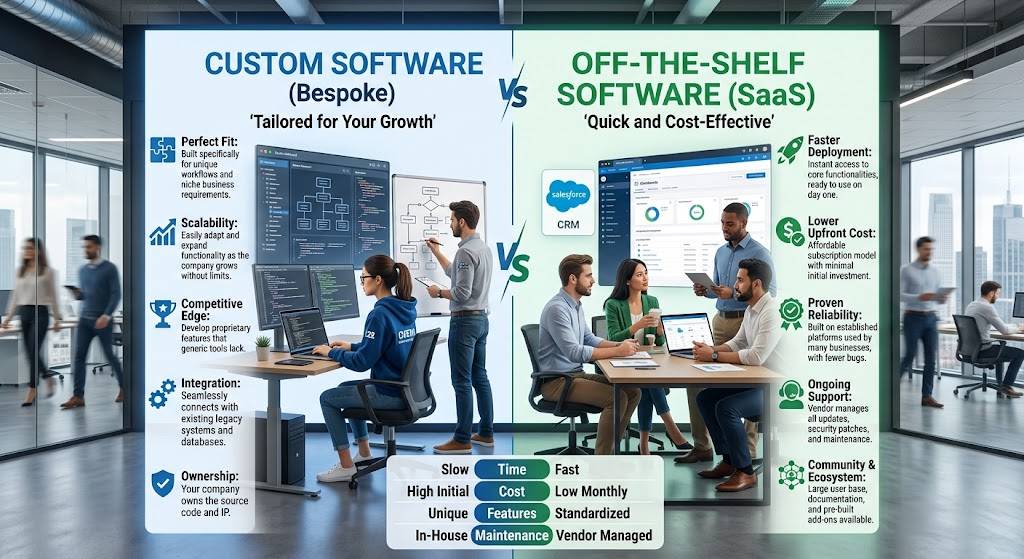
Choosing the right software can directly affect how efficiently a business operates.
Some companies rely on ready-made platforms for CRM, project management, accounting, scheduling, customer service, or internal operations. Others eventually reach a point where those tools no longer fit the way they work.
That is when custom software development becomes an important consideration.
Should the business continue using off-the-shelf software, or invest in a custom software solution?
There is no universal answer.
The right choice depends on the company’s workflows, budget, growth plans, integration requirements, and how unique its operational needs are.
Understanding the differences can help businesses make a more practical decision.
What Is Off-the-Shelf Software?
Off-the-shelf software is a ready-made product designed to serve a broad group of customers.
Examples may include CRM platforms, accounting tools, project management systems, scheduling applications, email marketing platforms, and customer support software.
These products are typically subscription-based and can often be implemented quickly.
Businesses usually choose a plan, configure the platform, import data, connect integrations, and begin using the system.
The biggest advantage is convenience.
The software already exists, so the business does not need to design and build everything from the beginning.
Advantages of Off-the-Shelf Software
Ready-made software can be an excellent option for many businesses.
Common benefits include:
- Faster implementation
- Lower initial cost
- Regular software updates
- Existing integrations
- Documentation and support
- Established security practices
- Familiar user interfaces
For businesses with relatively standard requirements, these platforms may provide everything needed.
For example, a small company may not need a custom CRM if an existing platform already handles contact management, pipelines, email automation, reporting, and appointment scheduling.
In that situation, building custom software could add unnecessary cost and complexity.
Limitations of Off-the-Shelf Software
The challenge is that ready-made platforms are designed for many different customers.
Your business has to work within the structure the software provides.
As operations become more complex, companies may begin creating workarounds.
Employees might export data into spreadsheets, manually transfer information between applications, or use several tools to complete one process.
Other limitations may include:
- Features you do not need
- Missing specialized functionality
- Limited customization
- Subscription costs that increase with users
- Integration restrictions
- Vendor dependency
- Complex workflows requiring workarounds
When employees spend significant time adapting their processes to the software, the system may no longer be serving the business effectively.
What Is Custom Software?
Custom software is designed specifically for the requirements of a particular business or organization.
Instead of adapting operations to fit an existing product, the software can be built around the company’s workflows.
A custom platform may include capabilities such as:
- Internal dashboards
- Customer portals
- Workflow management
- Inventory systems
- CRM functionality
- Reporting systems
- Mobile applications
- API integrations
- AI automation
- Custom approval processes
The objective is to create technology that matches how the business actually operates.
Advantages of Custom Software
The biggest advantage of custom software is flexibility.
The business can define exactly what the platform should do.
Workflows can be designed around existing operational processes rather than the limitations of a third-party application.
Custom software can also connect multiple systems.
For example, one platform could combine customer management, scheduling, billing, reporting, operations, and internal communication.
This can reduce the need to move information manually between several applications.
Other advantages may include:
- Greater workflow flexibility
- Custom reporting
- Unique business logic
- More control over integrations
- Branded customer experiences
- Reduced dependence on multiple tools
- Ability to evolve with business requirements
For organizations with specialized operations, these advantages can be significant.
The Trade-Off: Cost and Complexity
Custom software provides flexibility, but it also requires a larger commitment.
Businesses need to consider development, testing, security, maintenance, hosting, updates, documentation, and ongoing support.
The initial investment is generally higher than subscribing to an existing platform.
Development also takes time.
A business should therefore avoid building custom software simply because it wants a more visually attractive interface or a few minor features.
The investment makes more sense when the software solves an important operational problem.
When Off-the-Shelf Software Makes Sense
Ready-made software is often the better choice when:
- Business processes are relatively standard
- Existing platforms already meet most requirements
- The budget is limited
- The company needs a solution quickly
- Customization requirements are minimal
- The team does not want to maintain software
Startups and smaller businesses often benefit from using existing platforms first.
They can validate their processes before investing in something more customized.
When Custom Software Makes Sense
Custom software may become appropriate when:
- Existing tools cannot support critical workflows
- Employees rely heavily on manual workarounds
- Multiple systems create duplicate data entry
- The co