







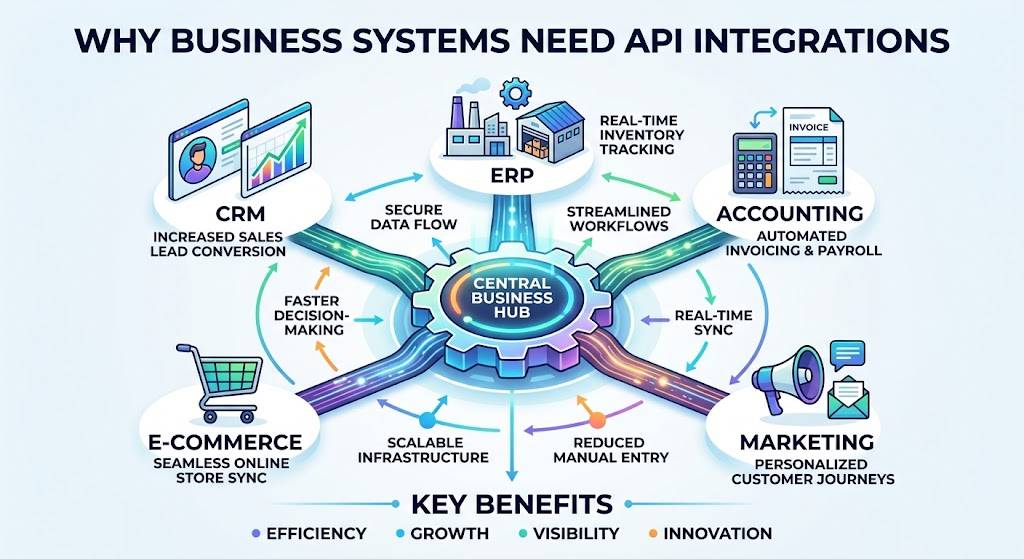
Modern businesses rarely operate with a single software platform.
A company may use one system for CRM, another for accounting, another for email marketing, another for scheduling, and additional tools for payments, reporting, customer support, project management, and internal operations.
The problem begins when those systems cannot communicate.
Employees end up copying information manually, exporting spreadsheets, updating the same customer data in multiple places, and checking several applications just to complete one process.
API integrations help solve this problem.
They allow different software systems to exchange information automatically and work together as part of a connected business infrastructure.
What Is an API Integration?
API stands for Application Programming Interface.
An API allows one software application to communicate with another application using a defined set of rules.
In simple terms, it acts as a bridge between systems.
For example, when a customer makes a payment online, an API integration could automatically:
- Confirm the payment.
- Update the CRM.
- Mark the invoice as paid.
- Send a confirmation email.
- Notify the operations team.
- Update a reporting dashboard.
Without integrations, employees may need to complete several of those steps manually.
With APIs, information can move between systems automatically.
APIs Reduce Manual Data Entry
One of the biggest benefits of API integrations is reducing repetitive data entry.
Businesses often enter the same information into multiple systems.
A sales representative may add a customer to the CRM. An accounting employee may then enter that customer into billing software. Operations may add the same information to a project management system.
This creates unnecessary work.
It also increases the risk of mistakes.
API integrations can synchronize data so information entered in one system automatically appears where it is needed elsewhere.
This reduces duplication and allows employees to spend less time copying and pasting information.
Connected Systems Improve Data Accuracy
Manual data transfer creates opportunities for errors.
Someone may type the wrong phone number, forget to update an address, duplicate a customer record, or enter outdated information into another platform.
When systems are integrated, data can move automatically.
For example, if a customer’s contact information changes in the CRM, the update may be passed to other connected applications.
This helps businesses maintain more consistent information across their technology stack.
Accurate data becomes especially important for reporting, customer communication, billing, and automation.
APIs Make Workflow Automation Possible
Many business automation workflows depend on APIs.
Automation platforms can use APIs to connect applications and trigger actions based on business events.
For example, when a new lead submits a website form, an integration can automatically:
- Create a CRM record
- Assign the lead
- Send a confirmation message
- Add the contact to an email sequence
- Notify the sales team
- Create a follow-up task
Instead of using each application separately, APIs allow the entire process to function as one connected workflow.
This is what turns individual software tools into a business system.
Customer Experience Becomes Faster
Customers do not care how many software platforms a company uses behind the scenes.
They expect a smooth experience.
Disconnected systems can create delays.
A payment may be received but not reflected in the customer account. A support agent may not be able to see order information. A sales representative may not know that a prospect already scheduled an appointment.
API integrations help information move faster.
That means customers can receive more accurate updates and employees can access better context.
A connected system can reduce delays between departments and create a more seamless customer experience.
APIs Improve Sales and CRM Processes
CRM platforms become much more useful when they connect with other business tools.
An integrated CRM may receive information from:
- Website forms
- Advertising platforms
- Email systems
- Calendars
- Phone systems
- Payment platforms
- Customer support tools
This gives sales teams a more complete view of the customer journey.
Instead of searching across multiple platforms, they can see more relevant information in one place.
For example, a salesperson may be able to see that a lead completed a form, opened an email, booked an appointment, and received a proposal.
That context can improve follow-up.
Reporting Becomes More Reliable
Business reporting becomes difficult when data is scattered across multiple platforms.
Marketing has one set of numbers. Sales has another. Accounting has revenue data. Operations tracks service delivery separately.
API integrations can bring this information together.
A reporting system can collect data from multiple sources and display it through one dashboard.
Managers can then track metrics such as:
- Leads generated
- Sales conversions
- Marketing performance
- Revenue
- Customer activity
- Operational performance
This creates better visibility and reduces the need to manually combine spreadsheets every week or month.
APIs Support Custom Software
Custom web applications often need to communicate with existing business platforms.
A company may build its own customer portal while continuing to use a third-party payment processor, accounting platform, email provider, or CRM.
APIs allow the custom application to interact with those services.
This means businesses do not need to rebuild every capability from scratch.
They can create specialized software while continuing to use established platforms for functions that already work well.
This is one of the strongest advantages of API-driven architecture.
APIs Help AI Systems Take Action
AI becomes more useful when it can connect to business systems.
An AI assistant that only answers questions is limited.
An AI agent connected through APIs can potentially retrieve information, update records, trigger workflows, schedule appointments, or perform other permitted actions.
For example, an AI customer service agent might:
- Receive a support request.
- Look up the customer record.
- Check order information.
- Review previous support history.
- Provide an answer.
- Update the support ticket.
APIs provide the connection between the AI system and the software where real business activity happens.
Security and Access Control Matter
Connecting systems also creates security responsibilities.
API integrations should be designed carefully.
Businesses should consider:
- Authentication
- Access permissions
- Encryption
- Data exposure
- Rate limits
- Error handling
- Monitoring
- Audit logs
An integration should only have access to the information and actions it actually needs.
Security should be planned from the beginning rather than added after the systems are already connected.
Build an Integrated Technology Stack
The value of business software increases when systems work together.
A CRM becomes more useful when it connects to the website.
A payment platform becomes more useful when it updates accounting automatically.
A scheduling system becomes more useful when it updates the CRM and sends reminders.
A custom web app becomes more powerful when it can access existing business services through APIs.
The goal is not simply to add more software.
It is to create a connected technology environment where information moves automatically, workflows operate efficiently, and employees spend less time managing disconnected systems.
API integrations are one of the key building blocks that make that possible.